

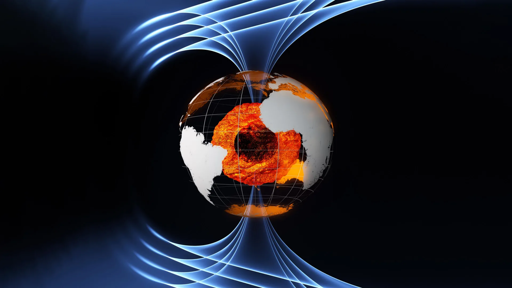
Earth’s molten outer core lies about 2200 km below the surface. As this electrically conducting liquid iron moves, it helps generate the planet’s geomagnetic field. For many years, scientists studying small variations in that field concluded that much of the outer core was flowing mainly westward.
That pattern changed dramatically in 2010. Beneath the Pacific Ocean, a large region of molten material began moving strongly eastward instead of continuing its weaker westward flow. Scientists still do not know what caused the reversal.
Satellite observations, including measurements from ESA’s Swarm and CryoSat missions, have now allowed researchers to study the event in greater detail.
Published in the Journal of Studies of Earth’s Deep Interior, the study combines ground-based observations with satellite measurements collected from 1997 through 2025. The researchers used data from ESA’s Swarm and Cryosat missions, along with observations from Germany’s CHAMP mission and the Ørsted mission.
Their analysis showed that a broad area of iron-rich fluid below the equatorial Pacific shifted from a weak westward flow to a strong eastward flow in 2010.
Scientists had generally viewed large-scale circulation in the outer core as relatively stable. The sudden change beneath the Pacific suggests that the system can vary much more quickly than previously believed. The findings offer new clues about the turbulent motions responsible for producing Earth’s magnetic field. They may also point to connections between activity in the outer core and changes taking place even deeper inside the planet.
link to open access paper https://jsedi.episciences.org/articles/17268
The ButterFry Effect