
- cross-posted to:
- environment@sh.itjust.works
Shit in, shit out?
Bullshit
Yes. Good one word summary.
Uh huh, and next they’ll put data centers in space!
🙄
I’m not convinced that this is 100% vegan solution. And that the cows and pigs agree with the concept of artificial “intelligence”.
To clarify, this is being pitched by the beef and dairy industry. It’s certainly not a vegan solution and it does not work as well as the industry claims
I was being ironic . Obviously, it doesn’t work so well as the industry claims, because in that case, there would be hundreds of giga reactors across the world to create energy out of shit 😁
Where is my shitpunk?
“This panopticon is powered by green energy, brought to you by Monsanto™ farms.”
Not really. Yes, you can turn manure into energy. But you would need vast amounts of it, and vast facilities, way bigger than the data centers, to turn manure into gas, and then gas into electrical power. And then you would need a fleet of trucks to move the remains of the process to somewhere.
Nothing but greenwashing. Just like the brain dead idea of green jet fuel and similar attempts.
Electricity was stupid expensive in the 90s in Ontario so it made sense to invest in cogeneration engines to burn digester gas or even natural gas and use the electricity on site. Then electricity got cheaper so it still made sense to burn biogas generated on site to lower your peak demands especially if you were paying time of use or you were Class A and needed to do load shedding. Sometimes you’d even get a discount from the electricity company for running your systems because it meant they could delay increasing the grid.
Now, the financial incentive is for carbon credits. You don’t get those if you burn on site, you just get to buy less taxed fuels. If you instead upgrade the gas to renewable natural gas (like what is described in the article) and put that in the natural gas grid, you can sell the carbon credits to companies who are required to offset their own generation. I think that is where the money is in these schemes.
(That and the tipping costs for food waste, free slowly digesting material to regulate the digesters in the form of the manure, outsourcing the annoying regulatory bits to the farmers, and building goodwill for green data centres)
Isn’t the world in need of good fertilizer? Why would you burn this manure instead of using it in crop lands and gardens and yards???
Actually, you don’t burn the manure. You get energy from composting manure, which produces gas, which can be burned in turbines to produce electricity. There are some local coops that do this.
The leftovers is fertilizer.
I promise this isn’t just a well askually but anaerobic digestion (what is being discussed in the article) and composting are different.
Composting requires oxygen. It produces carbon dioxide. It produces heat. Compost has less restrictions for use as a fertilizer than digested mature. I’m not from the US so I don’t want to assume it’s the same across all states but in Canada you can sell it to the public.
Anaerobic Digesters do not require oxygen. It produces carbon dioxide and methane. It requires heat input to occur at a reasonable rate. Use as a fertilizer is restricted because more pathogens survive. Hydrogen sulphide is produced so sometimes ferric chloride is added, and that reduces the amount of phosphorus available to plants.
One of the trade offs with digestion is that processing the digestate into something usable takes additional energy. If it’s a single farm and they are not taking additional feedstock it’s no more nutrients that they had before they started digesting. Chances are they can manage the nutrients on site and don’t need to input energy.
If they are taking stuff from off-site, or if they expended their operation beyond what they can manage on site then they need to choose if they are going to transport it off-site as a liquid, thicken it into cake (mmmmm), or create a fertilizer product like pellets. Each option requires more energy than the last. They may be able to sell the pellets but typically have to give liquid or cake away for free or pay people to take it.
While I really don’t think gas from manure is the grand solution to climate change like this article seems to state. It doesn’t actually make a difference when it comes to fertilizer. You don’t burn the manure itself, you burn the gas produced from the manure. Afterwards you have this black sludge that is actually an even better fertilizer than before because the digestion in the methane production process breaks down the organic matter in the manure and makes especially the nitrogen contained within shift from being tied up in proteins and organic matter to being pure ammonia and nitrate. I have myself witnessed how a local pig farmer increases his wheat yields significantly once he installed a biogas digester and started fertilizing with the pig manure digestate instead of raw pig manure.
If we are going to have animals, we might as well put all the manure into a biogas digester before using it as fertilizer. You can even run tractors off the stuff if they are properly concerted. A few farmers that have biogas digesters have totally stopped buying diesel.
However for the US specifically I think step 1 is starting to actually use the manure at all. You guys have these poop lagoons over there where the manure just rots in a pool and never gets used on the field. In the EU that’s illegal.
This industry is happy to let manure runoff into local ecosystems and lead to massive waterway pollution and toxic algae blooms. Biogas is no better with the tanks used for holding manure for biogas regularly leaking out and/or overflow
This is not an industry that is super concerned about fertilizer shortages and usage. Animal agriculture makes fertilizer demand increase and worsens the problem, even if manure was used 100% optimally
Thus, shifting from animal to plant sources of protein can substantially reduce fertilizer requirements, even with maximal use of animal manure
https://www.sciencedirect.com/science/article/abs/pii/S0921344922006528
For an example of how large the fertilizer difference can be: Producing 1kg protein from beans uses 12x less fertilizer than doing the same from beef
To produce 1 kg of protein from kidney beans required approximately eighteen times less land, ten times less water, nine times less fuel, twelve times less fertilizer and ten times less pesticide in comparison to producing 1 kg of protein from beef
So first data centers were loud and now they’re going to be stinky as well? Really selling these with the local communities, I see.
Capitalists will soon be raising cattle only for their shit. They won’t be used for dairy or meat, or anything else. Literally we are gonna have shit factories and pits of cow corpses whose shit production wasn’t keeping the line going up and to the right.
Bullshit in, bullshit out. That tracks.
Manure in, manure out
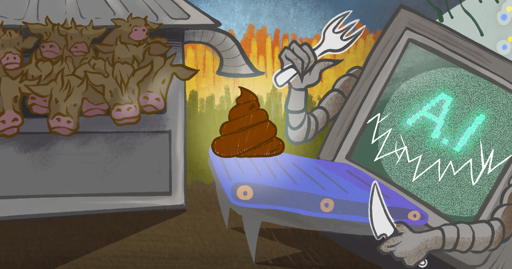
The operation, run by Pennsylvania-based Ag-Grid Energy, is the first of its kind in the country. The company claims the anaerobic digestion of manure and food waste could be a game-changer, not only in powering crypto, but data centers, which currently use 4.9% of the country’s electricity, a figure that could double by 2030.
There are a handful of net energy producing waste treatment processes in the world, and they all achieve it by taking advantage of hyper local opportunities to optimize. They are not infinitely scalable. For example, T. PARK in China takes sludge from several wastewater plants and uses the energy to power one of them.
Further, it is not truly net positive if it leaves residuals that need further treatment.
The project claims to recycle more than 45,000 gallons of food waste per day and the manure of 4,000 cows. “What we want to do is also provide, if possible through fiber optics, [the] value of the AI computing capacity to that same regional area,” Akki says.
The energy isn’t in the manure. Wastewater plants use food waste (co-digestion) to boost methane production of digesters. Some places get the food waste from a municipal green bin program but that’s a giant pain and wastewater plants tend to prefer food waste from food manufacturing. So it’s unclear if this is diverting the food waste from landfill. The best solution would be to reduce the food waste in the first place. Can you call it green if it is the result of over production?
Don’t get me wrong, I am pro-biogas. In municipal wastewater treatment the best results for biogas production come when you direct as much short chain carbon to the digester, which greatly reduces one of the highest electrical loads on the plant (blowers to oxidize carbon).
You’re still burning it though. It looks good on paper because the CO2 emissions don’t count in Canadian GHG reporting because the source is biogenic. Doesn’t change the fact that there are emissions.
The digested waste, or digestate, is meant to be recycled, potentially into a range of products, such as fertilizer and animal bedding.
The energy to turn digestate into a fertilize product is pretty massive. Many of the plants that are energy neutral incinerate and the ash is landfilled.
Digested manure can be more polluting than manure that hasn’t been digested, according to USDA research.
Eeeehhhhh… Technically true but only because people are allowed to operate digesters poorly. I was talking to an engineer in the states who told me his digester was losing 30% of the methane by leaks and I was sitting getting second hand panic but apparently that’s not super illegal? We would have problems with the environmental regulators and the TSSA.
The project intended to send about 41,000 gallons of waste per day into a tributary of Walla Walla Creek, which empties into Lake Michigan.
Excuse me what
There are some high level engineering plans available.
Some highlights:
There is also an air pollution permit application available. Additional details about the project include
The nutrient management permit application is behind a log in so I can’t see it but this article has statements from Vanguard that contradict the engineering plans.
Hanselman says the company never uses human waste in its digesters, which is how PFAS would enter the equation and that the sources of the other organic food waste would likely be byproducts from dairy processing and beer brewing.
The application included provisions for accepting packaged food. The packaging is where the pfas is.
The process Vanguard’s co-digesters use to clean the digestate on the back end, Hanselman says, allows for nutrients to be removed and taken away. That allows the farm to limit the amount of phosphorus and nitrogen that is spread on the farm’s land. He noted that at the company’s first project in Vermont, they’re removing 12 tons of phosphorus per day from the environment.
This is explicitly untrue for the Waupaca project? Vanguard has no part in digestate treatment. Sometimes there is phosphorus removal during H2S removal (if FeCl is used) but this project used a scrubber. So no nutrient reduction.
I obviously can’t speak for every project, but this example project would increase the amount of nutrients the farm has to manage (because of the trucked in food waste). It would increase energy consumption, and there was no plan for what to do with the digestate. It’s not even clear if there is a net methane release reduction over their previous methods because the carbon in the food is more likely to convert to methane in the digester. The more slow to break down carbon from the manure may still end up on fields.
Food waste digestion needs a less biodegradable feed stock to make the process more stable. In municipal wastewater you balance raw sludge (easily digestible) and secondary sludge (less easily digestible) to ensure the acetogenisis step doesn’t poison the methanogens step.
I don’t see a benefit to the local community in this proposal at all. If they treated the wastewater using energy efficient methods then maybe? But not this project as it was proposed. Vanguard gets the slowly biodegradable material, land to use, to be absolved of responsibility to deal with byproducts. Seems like a bad deal.
This has to be a troll right? Or one of those apocalypse accelerationist plans?