

The path from here to a finished product is still ongoing. The next prototype will include around 20 segments, targeting a 20 Kelvin temperature span and approximately 100 W of cooling capacity. “The first commercial application will be control cabinet cooling and photonics or laser cooling,” Vogel stated. “These are niche markets where conventional refrigerants are often not suitable due to safety requirements such as ATEX explosion protection.”
“We believe the technology could ultimately be around 20% more efficient than current vapor compression systems in the 100 W to 10 kW range. However, scaling becomes more difficult, as our system scales linearly with material usage, whereas compressors benefit from more favorable scaling effects,” Vogel concluded. “We therefore do not target very large systems such as hotel air conditioning, but rather applications below 10 kW, including residential-scale heat pumps.”
EDIT: Easily digested video about the underlying tech https://www.youtube.com/watch?v=GHl6buYjZGE
If you already know how typical heat pumps work, said video could be summed up by this illustration:
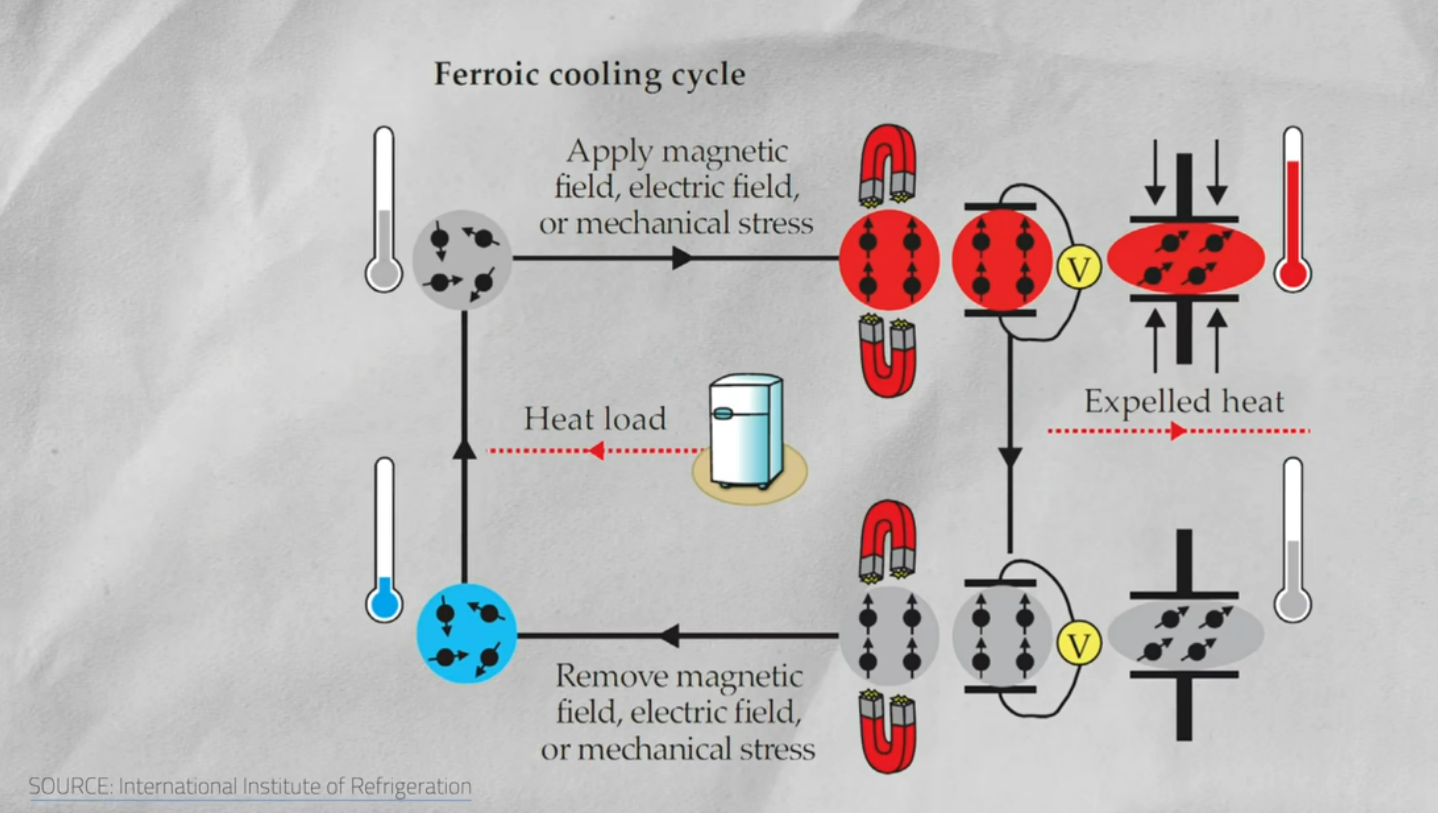
Interesting additional tidbit: theoretical coefficient of power is around 20 for this tech vs 3 for what we use. Problem: heat is absorbed and dissipated at the same place, so you still do need something that circulates it around, even if you don’t need a compressor anymore.
Absolutely true, and I was chewing over that while reading the article (are we good with TFA here, a la /.?). At that point we need a medium to transfer the heat at low pressure and then possibly another pump at the other end to dump the heat. I wonder if engine coolant would be sufficient.
As the video mentions, that’s not including a bunch of the required power to run an actual unit made to cool things like a fridge or air conditioner. The 3 COP number is inclusive of those extra power draws.
Absolutely, that’s why I’m mentioning it is a theoretical coefficient. It is worth noticing that the compressor, which is the part that’s being replaced here, is the main user of energy in a typical heat pump. So there is hope that if we get to the same level of engineering efficiency, we can get a very efficient system in the future. Maybe not up to 20, but certainly better than what we have now, and with a mechanically very troublesome part gone.
You have Alec’s attention.
And my axe!
Especially if you can integrate it with a ceiling fan
Ceiling fans are already 'integrated" with any other cooling/heating system improving their efficiency by distributing the air thus either aiding perspiration or avoiding gradients, that was a big point in the video.
Yeah but you need to have one for that
That’s how objects work
and through the magic of buying two of them, you can have two of them
This was a interesting read. I didn’t even know that electrocaloric materials existed. :)
Having read the explanation of how it works, I think the biggest difficulty waiting for them on the curve is achieving considerable levels of power.
But they seem to firmly believe that they can get past an instrument cooler to a residential heat pump.
I’m trying to understand. Is this a material that behaves as if compressed when electrified?
No compression or imitation of such. An electric field is used to manage the entropy of the material, and in a system of constant volume, entropy is directly proportional to heat.
The exact mechanism and the associated equations are a little beyond me, so I can be wrong on the rest, but if I got it right, the idea is to reduce entropy in part of the material, so the heat immediately flows into this part to get entropy balanced again, but by doing so it is moved from everywhere else, effectively cooling the other part of the material down.
I think I’m getting the mental model. It took me a minute to get how it cycles.
I think the material reduces entropy(atomic disorder), which is transformed into heat energy. Then you take that heat and move it elsewhere, say, into some coolant. Then that heated coolant is moved away, so when the power is deactivated the material re-entropizes(?), which transforms the same amount of heat in the material back into entropy, dropping its temperature.
I think the idea then is to use one way valves to let the expanded coolant move toward a heat sink side and then allow in fresh coolant from the heat source side. It’s not ‘solid state’ if you include the coolant system but it has definitely far fewer moving parts and far less friction than a common household heat pump.
This would be fascinating and ideal for many people’s homes. Especially if it is a window unit base.
Removed by mod
Omg heat pumps are so poggers i litrelally pissened my patns
Hey, man. People be downvoting you, but I want you to know I appreciate the energy you bring to a conversation.