If you already know how typical heat pumps work, said video could be summed up by this illustration:
Interesting additional tidbit: theoretical coefficient of power is around 20 for this tech vs 3 for what we use. Problem: heat is absorbed and dissipated at the same place, so you still do need something that circulates it around, even if you don’t need a compressor anymore.
As the video mentions, that’s not including a bunch of the required power to run an actual unit made to cool things like a fridge or air conditioner. The 3 COP number is inclusive of those extra power draws.
Absolutely, that’s why I’m mentioning it is a theoretical coefficient. It is worth noticing that the compressor, which is the part that’s being replaced here, is the main user of energy in a typical heat pump. So there is hope that if we get to the same level of engineering efficiency, we can get a very efficient system in the future. Maybe not up to 20, but certainly better than what we have now, and with a mechanically very troublesome part gone.
Absolutely true, and I was chewing over that while reading the article (are we good with TFA here, a la /.?). At that point we need a medium to transfer the heat at low pressure and then possibly another pump at the other end to dump the heat. I wonder if engine coolant would be sufficient.


If you already know how typical heat pumps work, said video could be summed up by this illustration: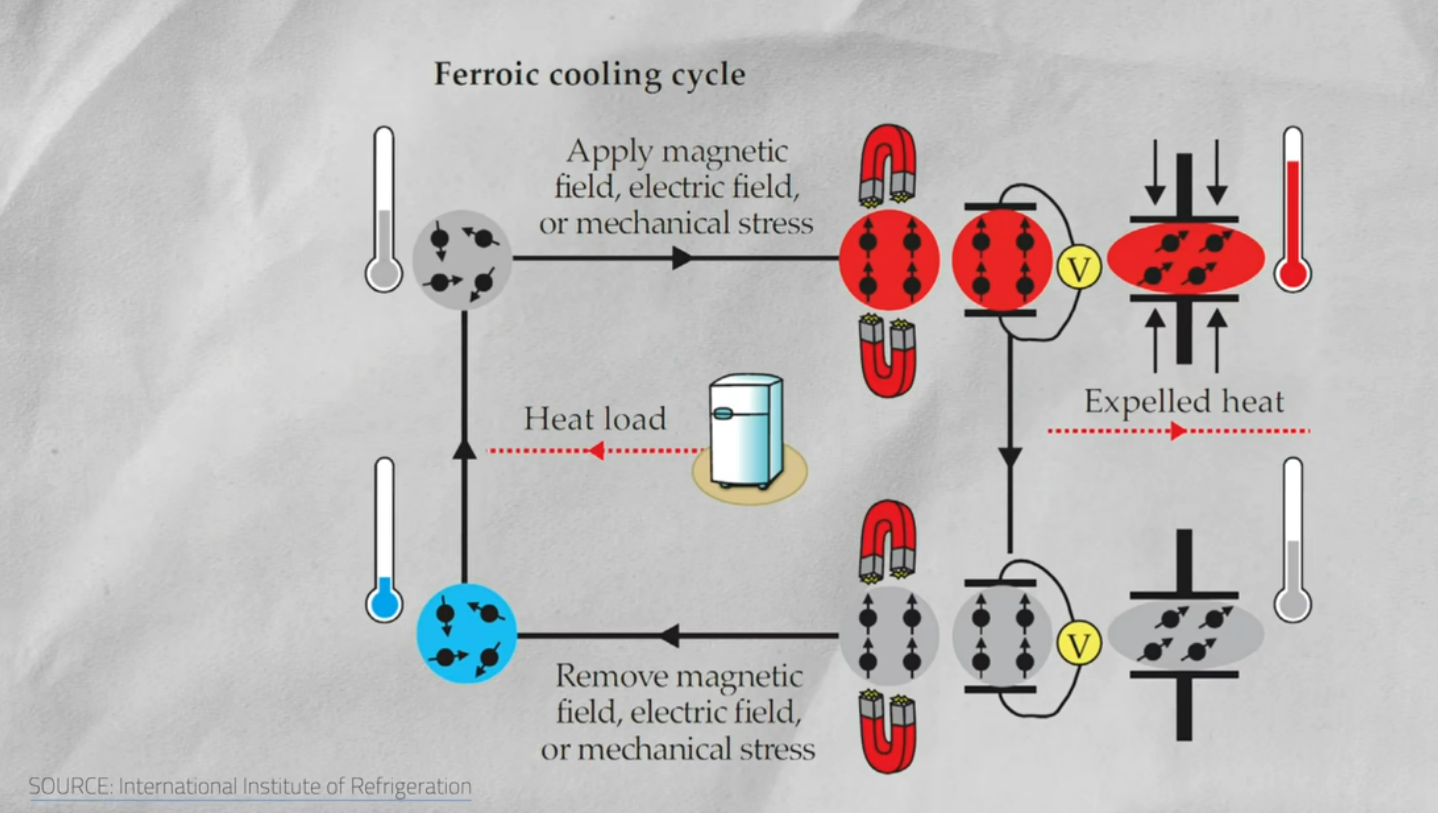
Interesting additional tidbit: theoretical coefficient of power is around 20 for this tech vs 3 for what we use. Problem: heat is absorbed and dissipated at the same place, so you still do need something that circulates it around, even if you don’t need a compressor anymore.
As the video mentions, that’s not including a bunch of the required power to run an actual unit made to cool things like a fridge or air conditioner. The 3 COP number is inclusive of those extra power draws.
Absolutely, that’s why I’m mentioning it is a theoretical coefficient. It is worth noticing that the compressor, which is the part that’s being replaced here, is the main user of energy in a typical heat pump. So there is hope that if we get to the same level of engineering efficiency, we can get a very efficient system in the future. Maybe not up to 20, but certainly better than what we have now, and with a mechanically very troublesome part gone.
Absolutely true, and I was chewing over that while reading the article (are we good with TFA here, a la /.?). At that point we need a medium to transfer the heat at low pressure and then possibly another pump at the other end to dump the heat. I wonder if engine coolant would be sufficient.