

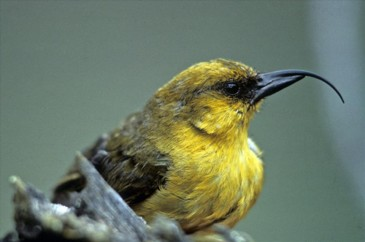
Dr Natalia Przelomska, from the University’s Institute of the Earth and Environment, was part of an international team led by scientists from the Smithsonian’s National Zoo and Conservation Biology Institute (NZCBI) and the National Museum of Natural History.
The study published in the Proceedings of the National Academy of Sciences, place both extinct and living Hawaiian honeycreeper species into their evolutionary context, helping scientists better understand biodiversity loss and informing future conservation priorities.
More than 60 Hawaiian honeycreeper species evolved from a single ancestor on the Hawaiian Islands over a relatively short period, making them one of the world’s best examples of adaptive radiation – the rapid diversification of one species into many new ones.
However, rapid diversification can make it difficult to reconstruct evolutionary relationships accurately. Today, that challenge is especially important because only 17 Hawaiian honeycreeper species remain, with most threatened by habitat loss, introduced diseases, invasive predators and climate change.
link to open access paper https://www.pnas.org/doi/full/10.1073/pnas.2536533123