
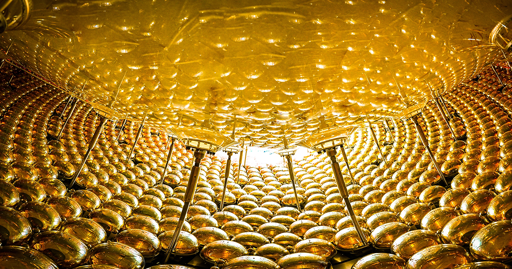
In counting geoneutrinos, physicists can get a direct measure of Earth’s vital heat-producing elements. “It’s the one thing we do that focuses on the Earth,” said Ryan Bayes (opens a new tab), a particle astrophysicist at Queen’s University in Ontario who works on SNO+. “Everything else we do is more focused on what we receive from other places in the universe.”
The first detection of geoneutrinos, by an instrument in Japan called Kamland, was reported in 2005. In 2009, the Borexino detector in Italy reported catching several dozen more. In November 2025, SNO+ reported (opens a new tab) its first detection, bumping up the number of observed geoneutrinos by about 50.
What makes the detections at SNO+ special is the experiment’s location: These are the first geoneutrinos measured in the western hemisphere, offering a new perspective on Earth’s radioactive interior.
…
The regions that seem to be producing the most geoneutrinos sit roughly above continent-size blobs of anomalously hot, dense material, known as large low-shear-velocity provinces, or LLSVPs, which seismologists have mapped on either side of the core. One is under Africa, the other under the Pacific Ocean. “There may be deep Earth structures in the mantle that are not understood,” Chen said. “It could be that [they] concentrate some kinds of elements.”