

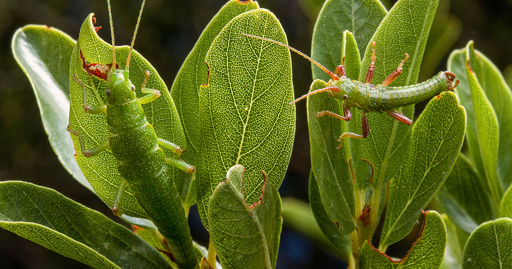
“It’s by far the most exciting time to be a biologist, ever, in my opinion — maybe with the exception of going right back to Darwin,” said Sean Stankowski (opens a new tab), an evolutionary geneticist at University College London. “Even when we understood that organisms were programmed by genetic code, we could really never access that. Now, we’re looking at every single [nucleotide molecule] — A, T, G, and C [adenine, thymine, guanine, and cytosine] — in the genome.”
An analysis of genomic ecotypes (opens a new tab) by Johannesson, Stankowski, and other researchers explains how some species can maintain the DNA sequences for multiple adaptations, allowing evolutionary processes to effectively select among ecotypes as environmental conditions change — sometimes within only a few generations. The data also suggests that some canonically diverse groups of species, including Darwin’s finches, may not be separate species at all, but rather different ecotypes of the same species.
an Explanation in the jargon of board game terms for board game nerds.
For a long time Evolutionary Biologists thought the evolution of species was like a Deckbuilder where trashing cards to thin out useless/lower value cards is an extremely powerful strategy, but now Scientists are beginning to reconsider whether or not the evolution of species is more like a Deckbuilder where trashing certainly does occur to evolve the Deck but the Deck is also expanded over time to balance more and more potentials with certain deck archetypes compressed into card powers through various mechanism that can be selectively emphasized to push the Deck composition into different optimizations, thus preserving a current effective Deck composition potential into the future without it being lost from trashing cards to address a current problem.