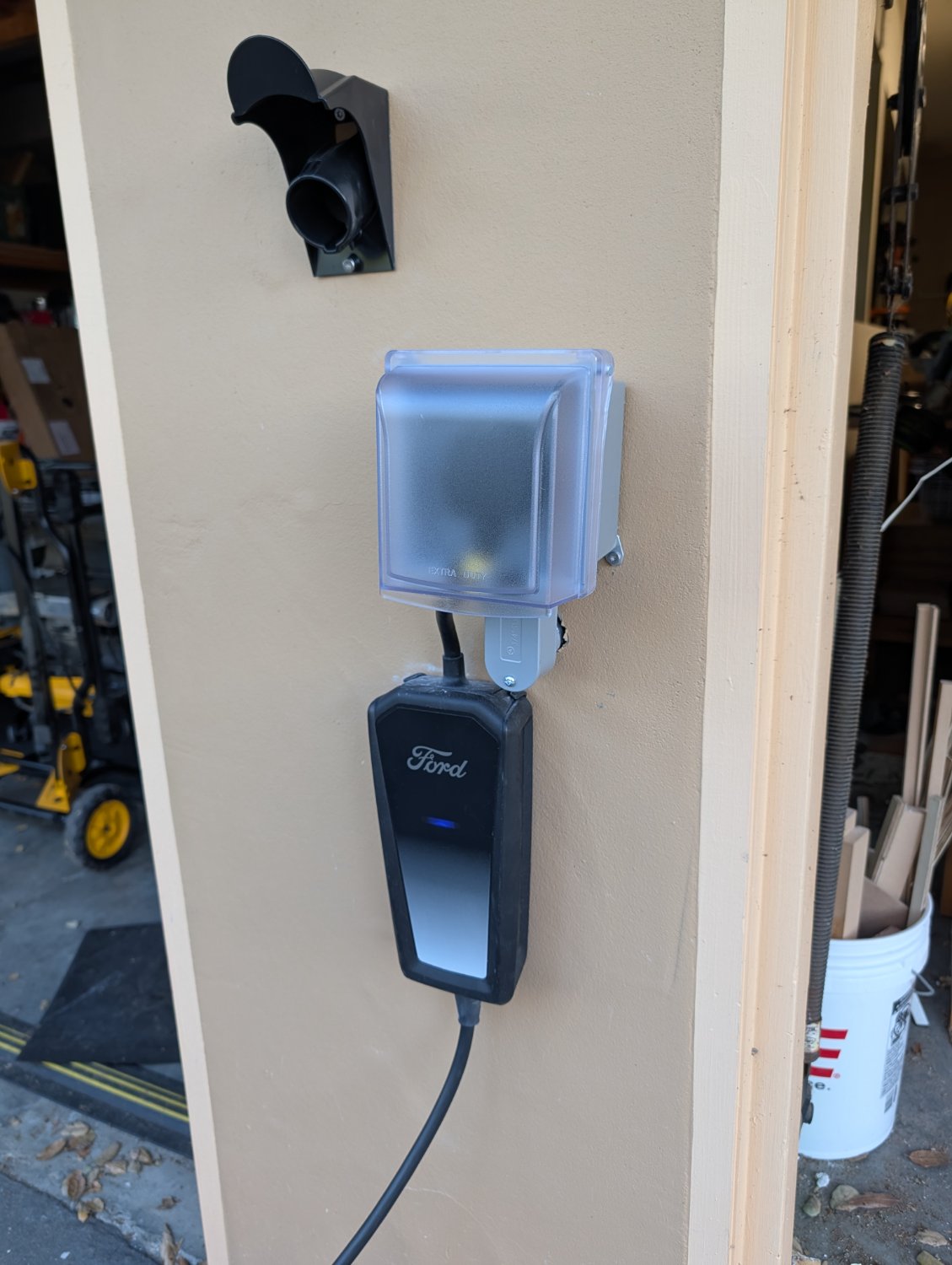
Installed a 40amp circuit for the EVs after charging a PHEV for 5 years and a BEV truck for almost a year on a single 15amp circuit.
50ft x 8 AWG x 4 wires isn’t cheap ($1.32/ft with tax), plus conduit, straps, breaker, wet location boxes and outlet cover and the extra cost for an EV rated outlet.
Wasn’t room between the post and the garage door king stud for a flush mount box, oh well.
I’ll pay the electrician for a proper hard-wired charger when we upgrade service and run it from the main panel instead.
The charger breaker should be in a separate heavy duty pony box, not a breaker on the main box.
Codes are way behind what they need to be for EV chargers, people are putting in 40A high duty cycle circuits on the cheap. That’s a lot of energy flow when things start arcing.
EV rated outlets are a scam. I know the Internet is obsessed with this idea, but all UL listed NEMA outlets are perfectly capable of carrying their full load indefinitely, as the tests literally require them to draw 125% of their rated capacity until temperature stops increasing, and that temperature cannot be more than the temperature rating for the THHN/THWN wire they serve - typically 75C. This is a perfect example of internet forum conventional wisdom flat out getting something wrong and then stubbornly doubling down on bad information.
Yeah, that makes a lot of sense. It wasn’t enough money to make me go down another research rabbit hole, which I suppose they basically count on.
Alec ( technology connections on youtube ) would be proud
His video convinced me to go for it (“it’s just wires”)! I had a double slot left in the panel. I’m now technically above the calculated load for our service, but I scheduled charging for late nights and below the max rating of the charger.
So all within safe limits. Noice ^^
do you need to have more amps than 15?
If you want to charge anything in under a day.
For commutes of an average length you don’t need more than a standard outlet if you leave the car plugged in when you’re not using it. However, a benefit of a level 2 charger is that if you have time-based electricity rates, you can schedule the car to charge only when electricity is cheapest, and get more kWh in less time.
The cars can do that though?
Kia’s scheduling is poor but functional.
Yes, but if you want all your power draw in this window you probably want more throughput. Plus if you do things other than commute it’s nice to have the flexibility. I get by fine for my normal commute on 15a but if I do things outside of going to work and can’t get a charger spot on my first day back from work it can be tight.
To charge faster, yes.
Here in the EU, 11kW home chargers are very common. Especially because three-phase power is common.
Really depends on how much somebody drives. I could probably squeak by on 1.2kw but the peace of mind of being able to crank it up to 11kw just in case is nice, doubly goes for the charger getting its own circuit. Typically I limit the charge to 2kw and the car is good to go overnight.
Slower charging is better for the battery anyway.
What size car battery have you? Mine is 64kw and I have a 7kwh charger at home. Overnight is ok but I cant imagine 1.2-2 being good enough.
77.4kwh iirc. The car doesn’t get a ton of miles every day, probably no more than 8kwh on average. It’s only when there’s a trip planned that requires a full charge do I bump up the charger power limits to be ready in time.
Most people probably don’t, it takes a while to charge but you could leave it charging all weekend.
With 2 vehicles to charge and one being a 130kwh truck, I needed a second circuit at the very least.
With how much I drive the truck (not a lot, I work from home, about to hit 3500 miles in 11 months), a 240v 20A is even more than enough. But I installed what the mobile charger you see is rated for (32A max, but the plug says 30A … ?) because I whole-ass anything I do. And now there’s a 14-50R for my dad to plug his camper into if he ever decides to visit his grandson.