

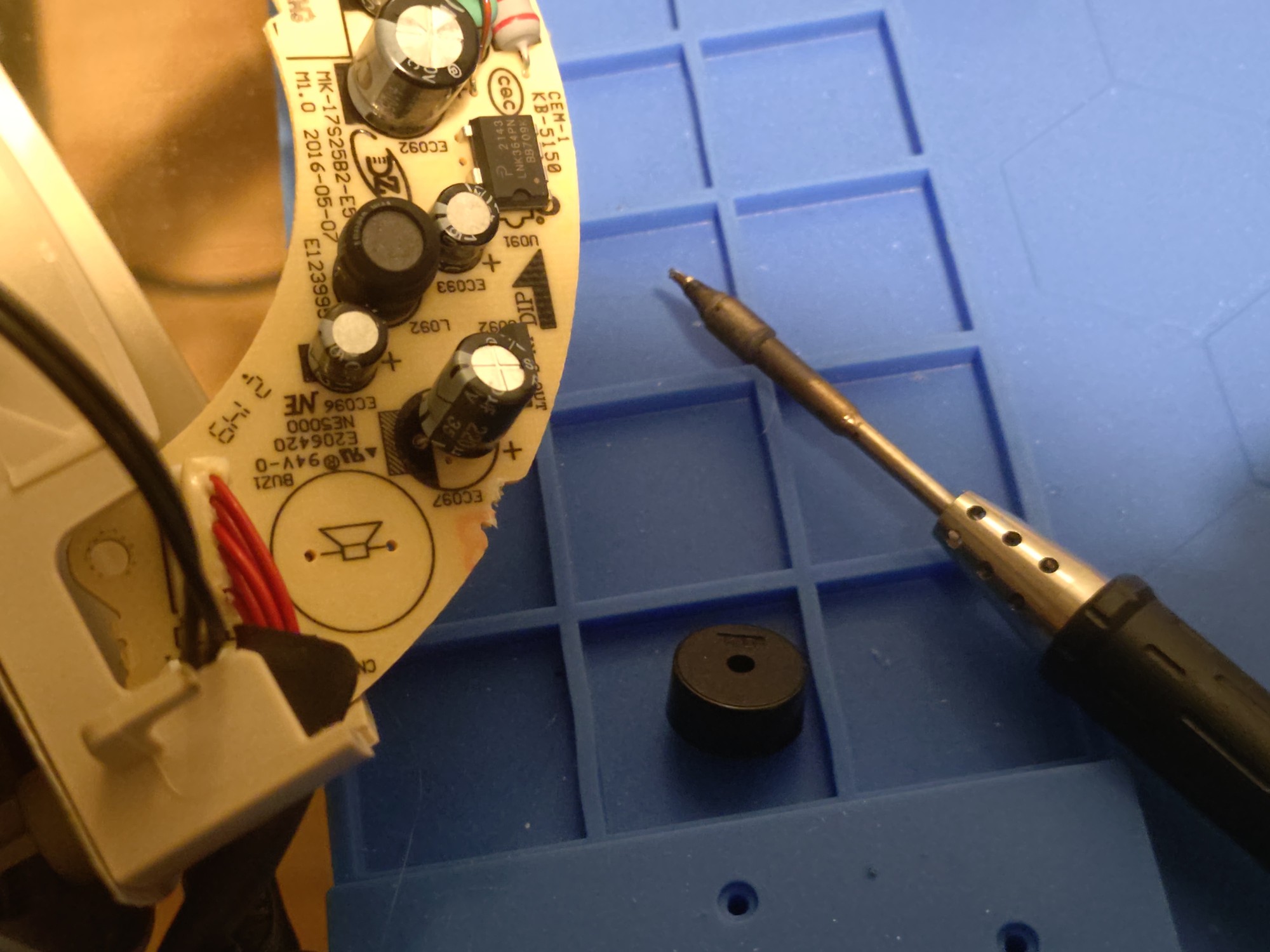
It beeps when it’s done.
It beeps when you press the button.
It beeps when you place it on the base.
But today, it beeps no more.
I classify this as a repair.
It beeps when it’s done.
It beeps when you press the button.
It beeps when you place it on the base.
But today, it beeps no more.
I classify this as a repair.
You know, that’s one thing I’ve wondered. Should you not have replaced the speaker with a very low resistance resistor so that it can dissipate that energy?
Like, I’m no electronics whiz or anything, but that energy is still gonna be sent that way. What happens when the path it wants to take is blocked? Could that cause upstream issues?
No.
The piezo beeper is between a positive rail and ground. Normally the positive rail leading to it is switched off, so no current flows through the beeper. When it’s supposed to beep, somewhere on the circuit a relay or transistor (or a pin on a microcontroller, but that just means a transistor inside the microcontroller) provides current to the rail, which takes the path of least resistance through the beeper into ground, which causes it to beep. The current then flows to ground where it effectively dissipates.
When the beeper is removed, all that happens when it’s supposed to beep is that the rail is switched on, but since there’s no path to ground through it, (practically) no electrons flow into it. While it is theoretically possible to design a circuit that would blow up when this happens, in practice it won’t ever be the case for low voltage electronics like this.
A helpful analogy is to think of electricity as water flowing through pipes, the piezo puzzer as a little water wheel, and the buzzer toggle switch as a valve. If you open the valve, water flows through the pipe and spins the water wheel. Remove the water wheel and plug the pipe next to it, and when the valve is opened all that happens is that the pipe fills with water up to the plug and then stops flowing.
Compare to a light bulb. When it burns out, the circuit is opened, just like our piezo buzzer being removed here.
There are some instances where a circuit going open can be very bad; those generally get fuses to cut off the supply. A transformer won’t like its secondary (load side) going open while a lot of electrons are still flowing through its primary (supply side), for example.
I’m also not an electronics expert either, but It don’t think it’s accurate to say the electricity is being “sent” to that component. I think it probably closes a relay or something and allows the electricity to flow through that particular part of the circuit. Removing the component probably just breaks the circuit.
But again, my knowledge is mainly limited to installing light switches and occasionally soldering wires together.