

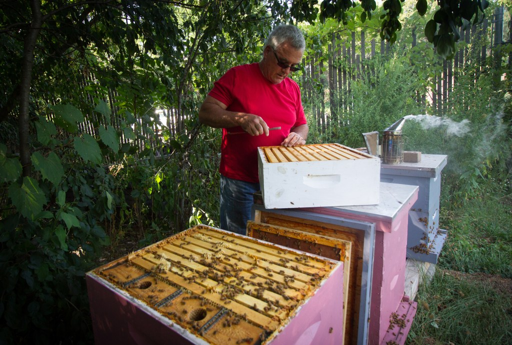
As honey bee colonies face mounting threats, veterinarians are becoming increasingly important to hive health. But high costs, limited training, and a shortage of bee specialists are slowing efforts to expand this emerging field. (Photo by David Cappaert, Bugwood.org)
[2026-08-14] Entomology Today — Veterinary medicine has always included insects, but only recently have veterinarians started actually treating insects. The earliest documented case of treating diseases vectored by insects dates back to 1890. Researchers at the U.S. Department of Agriculture at the time established that cattle fever was caused by ticks and could be managed by suppressing tick populations. Since then, the field of veterinary entomology has focused similarly on pest management and reducing the disease burden on domesticated animals.
Recently, however, pollinator populations have declined sharply in many parts of the world, resulting in the need for immediate intervention. These declines have been driven by a wide variety of factors including parasites, pathogens, and habitat loss. While managed pollinators like honey bees haven’t seen the same levels of population decline, they have been experiencing dramatic increases in colony loss rates. Increased colony loss rates are caused by a variety of stressors interacting with each other that reduce overall hive health. As these stressors accumulate, researchers are scrambling for solutions that either directly target bee parasites and pathogens or more broadly increase hive health.
The role of veterinarians comes into play when discussing managed pollinator populations. In 2017, the U.S. Food and Drug Administration (FDA) began mandating that antibiotics for bees must be prescribed by a veterinarian rather than purchased over the counter. This legislative change made it so, at least on paper, veterinarians would be much more involved in the health of honey bee hives. The change is called a veterinary feed directive (VFD) and was made due to the food products that come from honey bees. The VFD was introduced at a time when many were concerned about mounting antibiotic resistance in livestock. However, in practice there exist many barriers to veterinary care.
Barriers to Honey Bee Veterinary Care
One key barrier is cost. Consulting a veterinarian can cost hundreds of dollars on top of the charges associated with any pharmaceuticals that are prescribed. In many areas, these costs are comparable to simply replacing a hive, making veterinary care a less attractive option for many beekeepers.
Another key barrier to veterinary care is simply lack of access. Approximately 300 veterinarians are registered as members of the Honey Bee Veterinary Consortium. This consortium serves as the leading national organization for honey bee health information and diagnostic resources. For context, approximately 75,000 companion animal veterinarians currently practice in the United States.
A third barrier to usage of honey bee veterinarians is a perceived lack of knowledge and expertise. Many beekeepers are aware that bee medicine is often not well covered in veterinary curricula. A new study published in June further looks at the challenges facing veterinarians interested in practicing with bees. They find that the largest barriers to veterinarians are “lack of knowledge, education, skills, and training.” Veterinary schools are working to include more course work relating to bees. Additionally groups like the Honey Bee Veterinary Consortium work to offer education and resources to those who have already graduated.
A final barrier to veterinarians is a shortage of available treatment options. Currently only three antibiotics are approved for use in honey bee colonies. The lack of legally approved antibiotics likely comes from limited consultation between beekeepers and veterinarians. Because there is a lack of bee veterinary service usage, companies do not have incentives to develop and approve products for usage in honey bee hives.
Pioneering a Novel Relationship Between Insects and Veterinarians
Managing honey bees with medical intervention is a unique connection between entomology and veterinary medicine. Honey bees are currently the only invertebrates that are routinely offered this level of support at all. Honey bees are in many ways pioneering a beneficial relationship between insects and veterinarians. However, pioneering a path does not come without difficulty.
Overall the state of bee veterinarians is caught in a difficult cycle. Veterinary schools often devote limited time to bee medicine because they don’t expect many graduates to use those skills, as beekeepers rarely seek veterinary care. At the same time beekeepers avoid consulting veterinarians because they believe veterinarians lack the extensive hands-on experience that beekeepers themselves possess. Breaking this cycle will not be easy, but it is becoming increasingly important as the number of threats facing honey bees continues to grow. From Varroa mites to pesticide use to habitat destruction, our bees need new and advanced treatments for the diseases that threaten their health.
To effectively break this cycle, we need buy-in across the board. First and foremost, we need researchers to develop and test treatments for honey bees. For scientists to develop these treatments, they need both funding and access to laboratory spaces. Entomologists, veterinarians, and beekeepers need to band together to advocate for federal funding.
This can be achieved by writing or calling your representative directly or by joining existing campaigns like those run by Environment America. You can also offer your support to organizations that independently fund this research. Some such groups are Project Apis m. and the Eastern Apiculture Society. Finally, you can also participate in and support groups like the Entomological Society of America that go to Capitol Hill and advocate for funding and support for entomology broadly.
Veterinary students and veterinarians can also help by choosing to learn more about honey bees and hive health. This can be done by completing the National Veterinary Accreditation Program’s module on honey bee health or by joining the Honey Bee Veterinary Consortium (HBVC). Veterinary students can join or start chapters of HBVC on their campuses or sign up for elective beekeeping courses as they are offered.
Finally, beekeepers can form active relationships with their local veterinarians. These relationships are essential if they need to establish a veterinarian-client-patient relationship (VCPR) prior to obtaining any prescriptions. These relationships can also be helpful to both parties, as beekeepers can share their vast practical experience while veterinarians share their clinical education.
