

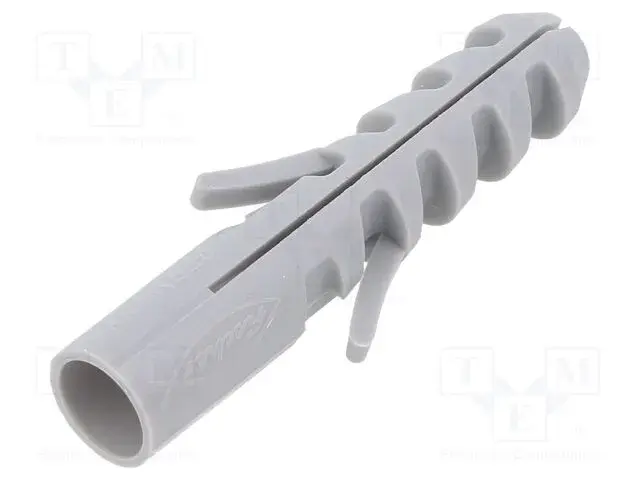
I used a 10mm masonry bit to drill for a 10mm plastic anchor like that pictured. The anchor spins freely in the hole, which I think is expected. I thought I read somewhere that the screw size should be 2mm less than the anchor. Thus 8mm for a 10mm ø anchor. But an 8mm screw is fat enough to rub sides of the anchor as it is inserted because I suppose the anchor is only 1mm thick at the opening. The guy at the shop confirmed that 8mm is too big. He said a 6mm screw matches and sold me those. After installing and loading, the anchor started to pull out.
Do I need a 7mm ø screw? Odd sizes get decreasingly common above 5mm. Yet 10mm sleeves are very common… so it’s not adding up.
I would like to have a reliable PDF chart of bore,anchor, and screw sizes – in metric. It seems there are plenty of such charts for Imperial/English units, like these:
- http://nfaspace.com/services/Forms_files/Anchor Classification Guide.pdf
- https://anchors.dewalt.com/anchors/_documents/uploads/DWANF_ICDWANCHSG_r01.pdf?1659150839
I’m not sure what a “#10” screw or anchor is (sometimes also written as “№10”). Does that refer to the metric size despite being in an imperial system?
(update)
The brick is rendered over with ~10mm plaster. The anchor is flush with the wall so about 10mm of the anchor is wasted. I think the anchor needs to be pushed in to be flush with the brick. But that’s a struggle. I think the proper approach is to screw in the screw just a couple rotations and then to hammer on the screw. But the anchor is either too big for the hole or something. The screw drives in but the anchor does not go with it. I think I will try softening the anchor with a heat gun and then try to push it in deeper. Or maybe I need a fatter screw just to drive the anchor in more.
The problem is worsened by the fact that as I screw, the anchor is coming out by about 5mm. So it’s even shallower than when I start screwing.
(update 2)
Now I see why I cannot get the anchor to be flush with the brick: I only drilled the hole deep enough for the anchor to be flush with the plaster layer.
So one theory is that I need to drill 10mm deeper so the anchor can be flush with the brick not the (useless) plaster. OTOH, the collar of the ancher seems a bit useless anyway for about 10mm.
Looks like you’re using the wrong kind of anchor dude. If you are mounting into brick you will need a specific type of anchor designed for brick. More like one of these
The plastic ones are designed for light loads and exclusively for plaster/drywall. Once you put the screws in and tighten it down the fins of the plug flare put behind the plasters it cant be pulled out without tearing out a chunk of wall. The brick anchors will flare out within the hole clamping itself against the inner wall of that hole.
These are for concrete when you need to hold 2000lbs. They’re not for brick.
There is so much wrong with this image I can’t help but wonder about the accuracy of those anchors.
This shows ribbed plastic as suitable in masonry.
The load is a bicycle. The bike is probably around 15kg. It’s at a 45° angle so the load would be a little more than half the weight (assuming it’s the cosine of 45°, not sure), plus the rack… all of which is well supported by cabinet hooks that take the sheer load. So the anchor in question is just holding the 45° angle of it all. After drilling deeper and adding a metal toothpick (effectively), it’s holding. But it does not feel solid so I am still looking at options.
The metal anchors you show would take on much more load. I’m not sure if I need them. How removable are they?
(edit) to give an idea of what I rigged up, the bike hangs like this:
My setup is slightly different because I have some wood on the wall and under the wheels.
It is a sleeve expansion bolt, sleeve is designed to blow out effectively into the material as the bolt tightens, so I think in general these are somewhat destructive, permanent fixtures. II think most of the time to fully remove requires a re-drill with a larger bit, so you could re-drill and then patch/fill. They can withstand crazy loads/force. Overkill for a bike, but would def work as a permanent solution - not what I would go for.
Sure you want to keep hat nice floating effect, minimal aesthetic. Those plastic insert sleeves should be fine if the hole is drilled precisely. You should blow out the bore hole to remove debris. You could glue the insert into the masonry, let that fully cure, and then drive the screws to get better expansion. Screws would be removable, but the plastic sleeve wouldn’t be. Good luck.