

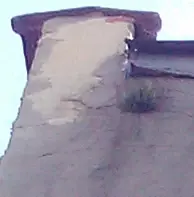
The linked pic shows the exterior where a plant is growing out of the wall. The wall is cracked and bulging. The pic is not good at showing 3 dimensions but the bulge is clear with a naken eye view. On the other side of the wall I could see the wood was a bit swelled and the plaster around it was very moldy. So I stripped off a lot of the moldy plaster. It was very soft from dampness. Fortunately, the mortar is still hard. Just the plaster was soft. Now looks like this:

Since the beam is likely structural, the safest option is probably to call in a pro. But fuck that, prices for pros are too crazy. I’m going to address this myself. My plan is to strip off all the loose concrete on the facade, as I hang from a rope (no scaffolding or ladder). I would then paint it with PVA¹ that is formulated for humidity and marketed to pros for the purpose of mixing with concrete. Straight PVA but diluted a bit with water as a 1st bonding layer. Followed by a slurry (small ratio of cement mixed with PVA & water). Followed by a thicker mixture for the 3rd bonding layer. And for the 4th stage I would do a normal blend of PVA + water + concrete and probably a plasicizer to get a heavy mix which will be the bulk of the render.
After rendering, I would never paint (I believe walls should breath), but I plan to finish with an “Aquaplan”-branded waterproofing layer, which claims to prevent water from penetrating (shows a pic of water beading up on a wall) while also claiming to be breathable.
What I am wondering is about this wood beam. I know there are costly chemicals for restoring wood which has been broken down by water. The stuff is supposed to penetrate into the wood and re-harden the fibers. I’m not sure what the chemical is or if it’s proprietary, but I wonder if I should try to track down that stuff and get it on the wood beam as a first step before rendering. Note that I won’t likely have access to the topside of the beam.
For longer-term protection, I might construct a small overhang so rain water is not constantly running on the facade in the future.
For the interior, I don’t think it matters what I do. I actually like the brick exposed for cosmetics and if I leave the wall open, it will help it breath and maintain a certain level of dryness (though limited in this humid region).
Anything else I should do, or not?
¹ polyvinylacetate
Yeah, it might be a good idea to check if the downspout isn’t partially clogged. I don’t know how high that building is, but around here, leaves can get in there every once in a while
If you haven’t checked yet, you might also want to see the abutment flashing (see #7 below) where that wall and roof meet, as water might be percolating in that area and getting trapped between the ceiling/drywall/insulation.
I’d also check the other flashings as well while you are at it and if that drywall and insulation on that affected area are damp, remove them for venting
I can’t tell too much from the pictures, nor feel and test the wood. You mentioned the plaster was soft, but what about the wood? Are there mycelium growth in it?
Check if the wood is dark, mushy, deformed, poke test it with a knife/awl/screwdriver, as wood with advanced decay will be soft and the probe will penetrate easily. How far does it go? How big is the beam? Do you know what kind of wood is it? Test in multiple areas
Tear up a more of the plaster to check how the rest of the beam looks like and test them. If it is less than 0.3 cm, venting might be enough
Another one is the pick test, where you insert the knife beneath the wood grain to pry loose a thin section of it till it breaks free. If you get a long linear splinter, itś most likely good, if it comes out as crumbly chunks or short pieces with a mushy sound, it is not ideal.
If you are in a dry season and no rain in sight, I’d clean both inside and outside areas to let them vent. Get a fan/dehumidifier/open windows in that room.
I also prefer breathable buildings, so you could use a more traditional breathable plaster, which allows water to easily evaporate over time, whereas concrete and all the PVA might help trap the moisture. It is typically made from lime and/or clay, sand, and water. You can also add fibers (horse hair or plant fibers) for strength
I appreciate all the advice! I still have to dig up the exterior but there is no growth of any kind on the interior side of the beam. It’s drying out and getting less soft as it dries, but still soft enough that I can stick needles in it ~2cm. The bottom side is the softest. I used a syringe to squirt in some wood hardener.
I am tempted to use pro-grade hydro PVA and plasticizer in the exterior concrete then finish with a waterproofing clearcoat that claims to still allow breathing. I believe that will mitigate rain saturating the facade. But on the inside wall I am tempted to not even plaster and just leave the brick and wood exposed. I would then expect water to not penetrate from the outside, but if it does so anyway then at least it could breath on the inside. I can also monitor it that way.