
cross-posted from: https://hexbear.net/post/7777980
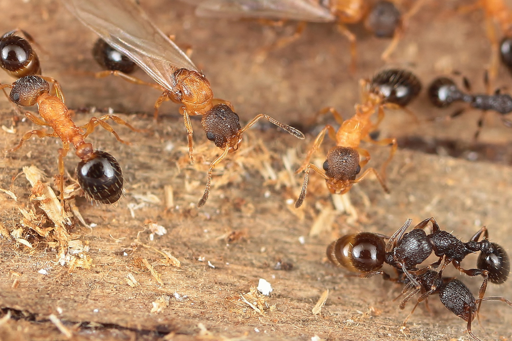
A new study has now provided the first proof of an ant species that lacks both workers and males and consists exclusively of queens.
💅💅💅💅
Ahhh, yes. Ants. My favorite ‘missed the mark’ discussion on my lack of hope in humanity was from my fellow anarchist friends. I am a staunch evolution nerd and they were like, ‘nah - traits that favor trashy brute behavior aren’t valid - just read Paul Kropotkin’s Mutual Aid to have a better feels.’ I did and got to chapter six before wanting to beat Paul’s ass because his argument was basically ’ trust in humanity and the world because insects like ants can get along’. Never mind the fact that if one ant doesn’t share what it has with another than the colony will dismember it. Or how other animals fear ant colonies when they move into their territory. Hope in humanity not restored and I also hate ants even more.
deleted by creator
“Now, the latest study shows that on top of killing the host queen, T kinomurai also reproduces asexually by producing clones of itself, and tricks the surviving host workers into rearing the offspring.”
So do the clones then convince the workers to kill the original clone? Repeat until the colony falls apart because workers aren’t being produced?
deleted by creator
IIRC, those specialists are antomologists.
Most often confused with a near-homonym, “ehtymologist”, someone who kinda studies ok words sometimes.
There’s gotta be a point at which sexual reproduction comes into play, otherwise it’s an evolutionary dead end
If that were true then sexual reproduction couldn’t possibly have evolved in the first place
When competing with an entire ecosystem of sexually reproducing species, it’s an evolutionary dead end.
Kinda seems like you don’t actually understand how evolution works
Can you explain why you think that?
Or an en evolutionary peak
Cloning!
Note: Typically ‘workers’ are non sexually reproducing females for ants
They then analysed the queen ants under a microscope and found that their mating structures were not used, essentially indicating that the offspring were all clones.
After observing multiple colonies and multiple populations of the species, researchers confirmed that the species completely lacked workers and males.
“Our data therefore suggest that the life history of T. kinomurai is characterised by the unique combination of workerless parasitism and parthenogenesis, i.e., the ability to produce female offspring from unfertilised eggs,” scientists wrote in the study published in the journal Current Biology.
Yeah I read it, I’m saying that if an animal is only reproducing via cloning forever, it’s an evolutionary dead end, because they will have completely lost the ability to adapt to environmental changes
No necessarily: mutations will still happen. But there will not be any genetic crossing over that will contribute to greater variance.
How many animals can you name that reproduce only asexually? The rate of evolution in an asexually reproducing species will always be significantly slower than a species that reproduces sexually, and over time it will be out-competed.
The rate of evolution in an asexually reproducing species will always be significantly slower than a species that reproduces sexually, and over time it will be out-competed
Again: not necessarily. That there are still asexually-producing organisms suggests that it’s not enough of a disadvantage for the environment they’re in.
This form of reproduction can also be an advantage: the rate of reproduction tends to be faster and more offspring are produced. In the case of this organism, instead of one queen producing all the offspring, every ant is able to produce offspring.
tl;dr: it isn’t the case that sexual reproduction is always favoured over asexual reproduction. Evolutionary pressure isn’t fixed like that.
Again, what other animals are there that reproduce only asexually? Of course there can be advantages to reproducing asexually, however every other multicellular animal that does it also reproduces sexually at times, because those that don’t reproduce sexually have gone extinct
From some quick research just now, all these species are female-only and reproduce asexually:
It’s nowhere near as common as sexual reproduction, but it doesn’t mean it’s an evolutionary dead-end.
those that don’t reproduce sexually have gone extinct
Plenty of sexually-reproducing species have gone extinct too: that’s not an argument that sexual reproduction is unfavourable.
Somebody phone Ru Paul.
Yaass Queen!
Conservatives seen sweating, drafting bills to ban them